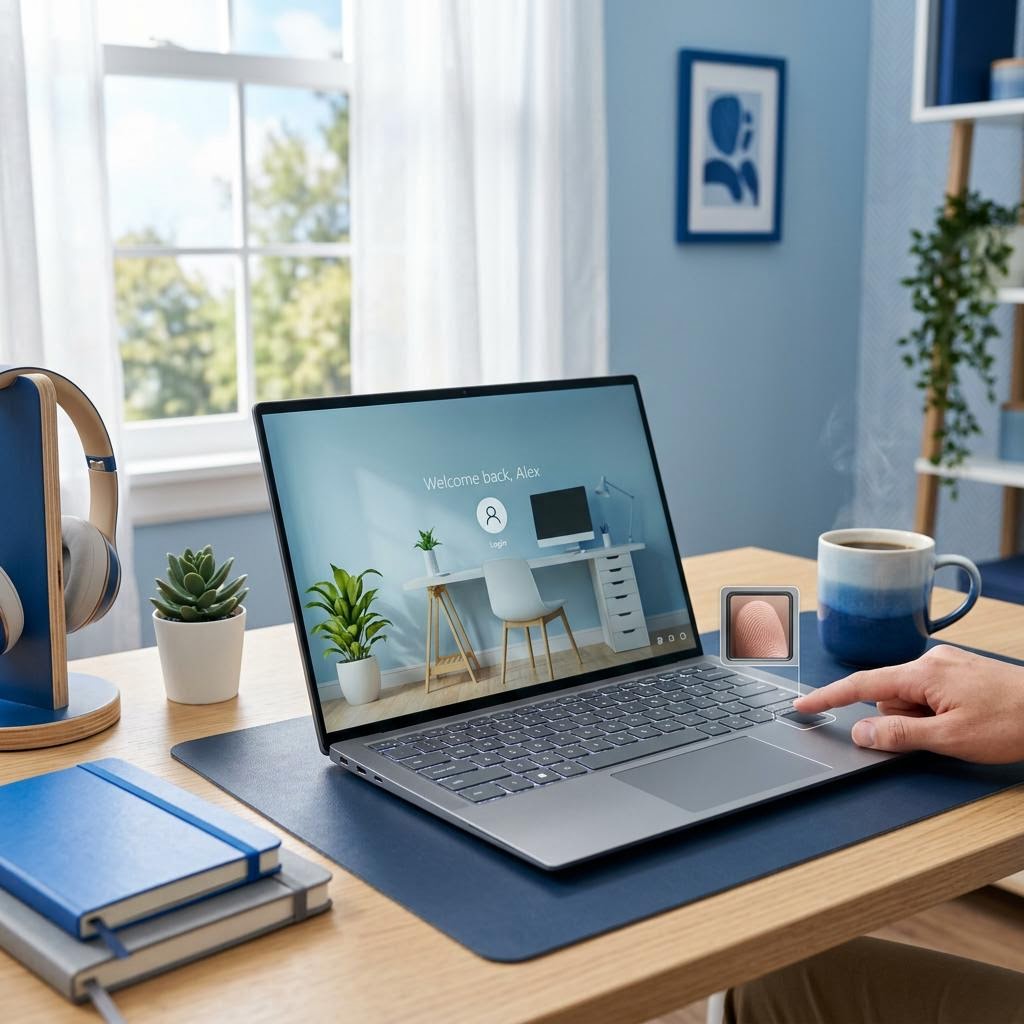
Windows Hello can use a compatible fingerprint reader or face-authentication camera, but ordinary fingerprint or RGB camera hardware is not automatically Hello-compatible. Microsoft defines biometric and face-camera requirements; the PC or device maker's exact-model documentation establishes whether the hardware is present and how its driver or firmware is packaged. Family names below are lookup labels, not universal packages. Match the PC model, hardware ID, firmware/revision notes, and Windows release. Keep a working PIN or other sign-in method available before changing biometric components; loss of biometric convenience should not be described as account lockout when another configured credential remains available.
A biometric driver connects a fingerprint reader or an infrared camera to Windows Hello, the framework that lets you sign in with a body trait instead of a password. The driver does not simply read a fingerprint or a face; it feeds the sensor's data into a secure pipeline that compares it against a template stored on the device, then tells Windows whether the match succeeded. The actual comparison and the stored templates are kept in a protected area, often a dedicated security component, so the biometric data does not travel as an image.
Biometric packages can be tied to a sensor, PC model, firmware revision, and Windows release. Use the OEM's model page where it publishes the applicable package; do not infer a required secure-processor or firmware bundle unless that model's documentation lists one.
Windows provides the biometric framework and service. Hardware and credential-protection implementations vary, so the presence, name, or packaging of a separate security component is model-specific.
Expanded guide insight
The practical biometrics context
Windows Hello needs a working sensor, a configured PIN, its service, and an enrolled fingerprint or face. Recognition failure is often fixed by re-enrolling—not by replacing a driver.
A PIN is the foundation for Windows Hello.
A regular webcam cannot add infrared face sign-in.
Driver updates can require biometric re-enrollment.
Take care: Do not clear the TPM to solve a sign-in problem unless you understand the BitLocker recovery consequences.
Fast checks for common biometrics problems
What you see
Likely area to check
Safe first move
Sensor stops responding after sleep
The device did not resume cleanly
Disable and re-enable the sensor in Device Manager
Fingerprint is no longer recognized
The saved template needs refreshing
Remove it and enroll the finger again
Windows Hello is unavailable
The PIN, service, or sensor is missing
Confirm the PIN and Windows Biometric Service first
Start with the lowest-risk check that matches what you see, then return to the detailed sections below if it does not resolve the issue.
Identify your exact device first
Open Device Manager and expand the Biometric devices section to find a fingerprint reader and read its exact name.
Expand the Cameras section and look for an infrared or IR camera entry, which is the sensor Windows Hello uses for face sign-in.
In Settings, open Accounts and then Sign-in options to see whether Windows Hello offers fingerprint or face setup, which confirms the driver is working.
Locate your machine's model, Service Tag, or serial number on its label or in system information, since the OEM site needs it.
Note the sensor's location, whether it is a standalone pad, built into the power button, part of a keyboard cover, or an external USB reader.
Check whether a privacy shutter or a disabled camera in Device Manager is hiding the IR sensor from Windows Hello.
10/11 only when the exact reader documents Hello support
Exact manufacturer and model on the device or packaging
Scan the list first, then open the family that matches your hardware for the full reference.
Reference coverage summarizes the Windows releases discussed in this catalog; it is not certified compatibility. Confirm the exact device or PC model, hardware revision, current Windows release, and current package requirements on the publisher source before making a change.
Documented biometrics families
Confirm the exact model and hardware ID explicitly support Windows Hello; install driver or firmware components only when that model's documentation lists them.
Reference coverage: 10/11 only where the exact PC or reader model lists support
This is the fingerprint sensor HP builds into many of its laptops, often set into the palm rest or the power button, to enable Windows Hello sign-in. HP validates the driver against each system and sometimes pairs it with fingerprint controller firmware, so the download tied to your exact model or serial number is the one to use. A generic driver for the same sensor frequently installs but does not surface the fingerprint option in Sign-in options.
How you recognize it
Listed under Biometric devices in Device Manager
Built into HP EliteBook, ProBook, and consumer laptops
Looked up by HP model or serial number
Download the biometric driver for your exact HP model or serial number.
Reference coverage: 10/11 only where the exact PC or reader model lists support
This is the infrared camera HP fits into the display bezel so Windows Hello can recognize your face even in dim light. It appears as a separate camera entry from the ordinary color webcam, and Windows Hello needs the IR entry specifically. Install the driver HP lists for your model, and check that no privacy shutter or disabled camera is hiding the IR sensor.
How you recognize it
Shown as an IR camera under the Cameras section
Distinct from the standard color webcam
Matched to the HP model on HP support
Facial recognition camera driver validated for your HP model.
Reference coverage: 10/11 only where the exact PC or reader model lists support
Dell's fingerprint readers on Latitude and other business laptops are commonly tied to ControlVault, a dedicated security processor that stores credentials and biometric data. Because of that pairing, the driver and ControlVault firmware are meant to be applied together, and both are found by entering your Service Tag. Skipping the firmware is a frequent cause of a reader that shows an error or refuses to enroll.
How you recognize it
Listed under Biometric devices, often with a ControlVault association
Common on Dell Latitude business laptops
Located by Dell Service Tag
Look up your Service Tag; ControlVault firmware may accompany the driver.
Reference coverage: 10/11 only where the exact PC or reader model lists support
This is the infrared camera Dell uses for face sign-in on models that support Windows Hello facial recognition. It enumerates alongside the regular webcam but serves the separate role of mapping your face for the secure comparison. Use the driver Dell matches to your system, and if setup fails, confirm the IR camera is enabled and enroll in even, moderate lighting.
How you recognize it
Appears as an IR camera under Cameras
Separate from the color webcam entry
Matched to the Dell system by Service Tag
Facial recognition camera driver matched to your Dell system.
Reference coverage: 10/11 only where the exact PC or reader model lists support
Lenovo places fingerprint readers on many ThinkPad and IdeaPad models, sometimes integrated into the power button, and the correct driver is located by machine type rather than a simple model name. Lenovo may include controller firmware with the driver, so take the whole package for your machine type. If Sign-in options omits fingerprint despite a visible reader, a missing Lenovo driver is the usual reason.
How you recognize it
Listed under Biometric devices in Device Manager
Found on ThinkPad and IdeaPad models, often in the power button
Located on Lenovo support by machine type
Match by machine type on Lenovo support for the correct driver.
Reference coverage: 10/11 only where the exact PC or reader model lists support
Supported ThinkPad and IdeaPad models include an infrared camera for face-based Windows Hello sign-in, distinct from the color webcam. The driver is validated for the specific model and looked up by machine type on Lenovo support. When facial setup will not complete, verify the IR camera entry is present and not blocked by a ThinkShutter or similar privacy cover.
How you recognize it
Shown as an IR camera under the Cameras section
Present on supported ThinkPad and IdeaPad models
Found on Lenovo support by machine type
Facial recognition camera driver for supported ThinkPad and IdeaPad models.
Reference coverage: 10/11 only where the exact PC or reader model lists support
ASUS integrates fingerprint sensors into many of its laptops, frequently combined with the power button, to enable Windows Hello. ASUS publishes the driver on the support page for each specific laptop, and because it uses several sensor suppliers, the download is model-specific rather than universal. Confirm your exact laptop model before installing so the reader is properly recognized.
How you recognize it
Listed under Biometric devices in Device Manager
Often combined with the power button on ASUS laptops
Downloaded from the model-specific ASUS support page
Download from your specific ASUS laptop support page.
Reference coverage: 10/11 only where the exact PC or reader model lists support
This covers the infrared cameras ASUS uses for facial recognition sign-in on Windows Hello-capable models. The IR camera is a separate device from the standard webcam, and Windows Hello depends on that IR entry being present and driven correctly. Install the driver ASUS validated for your model, and enroll your face in balanced lighting for the best result.
How you recognize it
Appears as an IR camera under Cameras
Distinct from the color webcam
Validated for the specific ASUS model
Facial recognition driver validated for your ASUS model.
Reference coverage: 10/11 only where the exact PC or reader model lists support
Acer offers fingerprint readers on select laptops to support password-free sign-in through Windows Hello. Because Acer sources sensors from more than one vendor, the correct driver is the one Acer lists for your model or serial number rather than a generic build. Use Acer support to fetch it, and confirm the Windows Biometric Service is running before enrolling.
How you recognize it
Listed under Biometric devices in Device Manager
Found on select Acer laptops
Looked up by Acer model or serial number
Use Acer support with your model or serial number.
Reference coverage: 10/11 only where the exact PC or reader model lists support
This is the infrared camera Acer uses for facial recognition on systems that support Windows Hello face sign-in. It shows up as its own camera device beside the ordinary webcam, and only the IR entry drives Hello. Install the matching Acer driver, and if enrollment fails, check that the IR camera is enabled and not covered by a physical shutter.
How you recognize it
Shown as an IR camera under the Cameras section
Separate from the standard webcam
Matched to the Acer model on Acer support
Facial recognition camera driver for supported Acer systems.
Reference coverage: 10/11 only where the exact PC or reader model lists support
On Surface devices, fingerprint reading may live in the detachable Type Cover keyboard or in the device itself, depending on the model. Microsoft services these readers through Surface support and Windows Update together, so keeping the device current usually keeps sign-in working without a separate hunt. If the reader is in a Type Cover, make sure that cover is the version with the fingerprint sensor.
How you recognize it
Listed under Biometric devices when present
May reside in a Surface Type Cover keyboard
Serviced through Surface support and Windows Update
Serviced through Surface support and Windows Update.
Reference coverage: 10/11 only where the exact PC or reader model lists support
This route covers Surface models whose specifications explicitly include Windows Hello face authentication; it is not present on every Surface configuration. Microsoft services applicable camera and firmware components through Windows Update and model-specific Surface packages. Identify the exact Surface model and Windows edition before using a package.
How you recognize it
Exact Surface model specifications list Windows Hello face authentication
Applicable components appear in the model-specific Surface update history or package
Facial recognition on Surface devices via Surface support and Windows Update.
Reference coverage: 10/11 only where the exact PC or reader model lists support
Samsung fits fingerprint readers into Galaxy Book laptops, frequently in the power button, to bring phone-style sign-in to Windows. Samsung distributes the driver through its own support software and relies on Windows Update for supporting components, making the update path more automatic than manual. Confirm your Galaxy Book model actually includes a fingerprint reader before expecting the option.
How you recognize it
Listed under Biometric devices in Device Manager
Often built into the Galaxy Book power button
Delivered through Samsung support and Windows Update
Use Samsung support and Windows Update for the biometric driver.
Reference coverage: 10/11 only when the exact reader documents Hello support
This route is a generic search label, not a package or compatibility approval. External readers differ in biometric certification, driver delivery, architecture, and supported Windows releases. Confirm the exact maker and model explicitly documents Windows Hello and use only its instructions or applicable in-box support.
How you recognize it
Exact manufacturer and model on the device or packaging
Hardware ID in Device Manager
Maker documentation explicitly lists Windows Hello
Many external readers use inbox Windows Hello support; get extra software from the device maker.
Device Driver Guide does not host, mirror, or alter driver files. The official-source citations below are maintained separately from this reference material and never point to third-party mirrors.
Where the correct package usually comes from
For a built-in biometric device, begin at the computer maker's exact-model page and install only biometric driver or firmware entries whose applicability notes match. A general support selector is not proof that a separate package exists, and not every model uses a secure-enclave or controller-firmware download.
Windows itself supplies part of the chain. The Biometric Service is built in, and Microsoft delivers some supporting components through Windows Update, so keeping Windows current is part of keeping sign-in healthy. External USB readers that advertise Windows Hello support often work on inbox support, with any extra software coming from the reader's own maker rather than from a PC vendor.
Official sources and citations
These links serve two different purposes. A manufacturer support selector helps you find an exact model, but does not prove that a package or feature exists for every product in a family. Claim-specific documents explain the cited technology, requirement, lifecycle, or bounded package example. In either case, check the publisher domain, exact model and hardware revision, operating-system release, supported-products list, and package notes before making a change.
Microsoft Lifecycle: Lifecycle documentation for Windows 10 Home and Pro; separately governed editions and servicing channels can have different dates.
Microsoft Surface: Use this publisher-maintained page to match the exact Microsoft Surface model and operating-system release before selecting a package.
Samsung: Use this publisher-maintained page to match the exact Samsung model and operating-system release before selecting a package.
Device Driver Guide is an independent reference, not a repair or technical-support service. It does not host or mirror installers and receives no payment for these links. A named-model package example applies only to the systems and operating systems on that publisher page; it is not a recommendation to install the package across a family. Report a moved or incorrect link through the correction form.
Biometrics reference tables
Where to get the biometric driver
Device
Correct source
What to avoid
Built-in fingerprint reader
PC maker support by model or Service Tag
Generic sensor-chip driver that hides Hello
Built-in IR camera
PC maker support, matched to the model
Assuming the color webcam driver covers it
Reader tied to a secure processor
Maker package with matching firmware
Installing the driver but skipping firmware
Supporting Hello components
Windows Update
Turning updates off and going stale
External USB reader
Inbox Hello support, extras from the maker
Third-party mirrors for a Hello-branded reader
Which source is correct for each kind of biometric device, and what to avoid.
Fingerprint reader versus IR camera
Aspect
Fingerprint reader
IR camera
Listed under
Biometric devices
Cameras, as an IR entry
Common location
Power button or palm rest
Display bezel, beside the webcam
Blocked by
A dirty or worn sensor
A privacy shutter or disabled camera
Enrollment tip
Capture several angles and pressures
Enroll in even, moderate lighting
Confused with
Nothing on the PC
The ordinary color webcam
How the two Windows Hello sensors differ so you troubleshoot the right one.
Symptom to likely cause to first safe step
Symptom
Likely cause
First safe step
Fingerprint option missing
OEM driver missing or wrong
Install the OEM driver, check the Biometric Service
Reader shows an error
Driver installed without firmware
Reinstall the package with its firmware
Face setup will not complete
IR camera disabled or blocked
Enable the IR camera, open any shutter
Hello broke after an update
Feature update swapped the driver
Sign in with your PIN, reinstall the OEM package
Valid finger rejected often
Dirty sensor or stale enrollment
Clean the sensor, delete and re-enroll
Webcam works, Hello face does not
IR sensor unconfigured
Install the IR camera driver from the maker
Common Windows Hello symptoms mapped to a probable cause and the safest first move.
When updating helps, and when it does not
Update a biometric driver deliberately, not routinely. Good reasons include a fingerprint or face option that has vanished, a sensor that stopped reading after a Windows change, or an applicable security advisory from your PC maker. A bad change can remove biometric sign-in convenience, so verify another configured credential before changing the model-specific package.
Follow the exact model's installation order when the maker documents related driver and firmware components. Keep a tested PIN or other credential available before any change.
Before you install anything
Confirm you know your Windows PIN and account password, since Windows Hello may be unavailable during the install.
Note the exact device names under Biometric devices and Cameras so you can tell if anything changes.
Look up your model, Service Tag, or serial number so you fetch the package built for your machine.
Check whether the maker ships separate secure-enclave or controller firmware to apply with the driver.
Create a System Restore point in case the change disturbs sign-in more broadly.
How to update biometrics drivers
1
Record your PIN and password first
Before changing biometric drivers, confirm you know your Windows PIN and account password. If Windows Hello stops working during the process, you must still be able to sign in by other means.
2
Identify the biometric device
Open Device Manager and expand Biometric devices for fingerprint readers and Cameras for IR facial-recognition hardware. Note the exact device name, and check your model or serial number for the download step.
3
Download the OEM package for your exact model
Go to your PC or laptop maker's support site and select your model, Service Tag, or serial number. Install the biometric driver, and apply any accompanying secure-enclave or firmware component the maker provides.
4
Reboot and confirm the biometric service
Restart the PC. Make sure the Windows Biometric Service is running, then open Settings, Accounts, Sign-in options to verify Windows Hello now offers fingerprint or face setup.
5
Enroll and set a fallback
Enroll your fingerprint or face in Sign-in options, and keep your PIN as a fallback. For fingerprints, capture multiple angles; for face, enroll in normal lighting and, if offered, add an appearance for glasses.
Confirm the install actually worked
Reboot and confirm the fingerprint reader or IR camera appears in Device Manager without a warning icon.
Open Settings, Accounts, Sign-in options and confirm Windows Hello now offers fingerprint or face setup.
Check that the Windows Biometric Service is running before you try to enroll.
Enroll a fingerprint or face and then lock the PC to confirm it actually signs you in.
Verify your PIN still works as a fallback after enrollment.
Undoing a bad biometrics install
If a biometric update breaks Windows Hello, first sign in with your PIN or password, which is exactly why keeping them ready matters. Then open Device Manager, find the fingerprint reader or IR camera, and use Roll Back Driver on its Driver tab to return to the version that worked, rebooting afterward to let the Biometric Service pick it up.
If firmware or a secure-enclave component was also updated, a driver rollback alone may not be enough because the pieces must match. In that case reinstall the exact OEM package your model shipped with, apply its driver and firmware in the maker's stated order, then remove and re-enroll your fingerprint or face in Sign-in options.
As a last resort, a System Restore point taken before the change reverts the driver, firmware, and service state together, after which you re-enroll your biometrics.
A generic driver for the same sensor chip often installs but fails to expose Windows Hello, leaving fingerprint or face setup missing.
Updating the driver without the matching secure-enclave firmware can break the sign-in chain even though the device looks fine.
A Windows feature update can swap a specialized biometric driver for a generic one and silently disable Hello.
Removing or resetting biometrics removes that sign-in convenience; confirm another configured credential works before proceeding.
A closed privacy shutter or a disabled IR camera makes face sign-in fail in a way that mimics a driver fault.
Automated driver updaters are especially dangerous here, since a wrong biometric driver can disable fast sign-in outright.
Mistakes to avoid with biometrics
Installing a generic driver for the same sensor chip, which often hides the Windows Hello option entirely.
Applying the driver but skipping the matching secure-enclave or controller firmware, breaking the sign-in chain.
Resetting biometrics without knowing the PIN and password, and getting locked out of the account.
Blaming a driver when a closed privacy shutter or disabled IR camera is the real cause of face failure.
Assuming the color webcam driver also drives the separate IR camera Hello needs.
Letting a driver updater replace a working biometric driver and disabling fast sign-in.
Enrolling a fingerprint with a single angle, so everyday reads are rejected.
Situations readers arrive with
My laptop clearly has a fingerprint reader, but Sign-in options does not offer fingerprint at all.
The biometric driver is likely missing or generic. Go to your PC maker's support site, enter your model or Service Tag, and install the OEM biometric driver plus any accompanying firmware. Confirm the Windows Biometric Service is running, then reboot and check Sign-in options again.
Face sign-in stopped working right after a big Windows update, and I cannot set it up again.
A feature update can swap a specialized driver for a generic one. Sign in with your PIN, then reinstall the OEM IR camera driver and any related firmware for your exact model. Confirm the IR camera is enabled and not blocked by a shutter, and re-enroll your face in even lighting.
I want to reset my biometrics but I am worried about getting locked out.
Before removing or resetting anything, confirm you know your Windows PIN and account password so you typically have a way in. Create a System Restore point, then make the change. Re-enroll your fingerprint or face afterward, and verify the PIN still works as a fallback.
A driver updater flagged my fingerprint sensor as out of date and wants to update it.
Do not accept the suggestion without checking the PC maker's exact-model support page. A mismatched package can disable Windows Hello. Update only when the maker lists an applicable package or correction, and verify your PIN or another credential before changing it.
My webcam works fine for video calls, but Windows Hello face sign-in does not set up.
The color camera can work while the separate IR sensor is unconfigured. Install the IR camera driver from your PC maker and confirm both the color and IR entries appear in Device Manager. Make sure no privacy shutter covers the IR camera, then enroll your face in moderate lighting.
Symptom-by-symptom troubleshooting
Windows Hello fingerprint option is missing
Install the OEM biometric driver for your exact model, confirm the Windows Biometric Service is running, and reboot. A generic driver often will not expose the Windows Hello setup option.
Facial recognition fails to set up
Update the IR camera driver from your PC maker, check that the IR camera is enabled in Device Manager and not blocked by a privacy shutter, and try enrolling in even, moderate lighting.
Fingerprint sign-in stopped after a Windows update
Reinstall the OEM biometric driver and any secure-enclave firmware, since feature updates can replace a specialized driver. If needed, remove and re-enroll your fingerprint in Sign-in options.
Sensor reads intermittently or rejects a valid finger
Clean the sensor, then delete the existing enrollment and re-enroll capturing several angles and slight pressure variations. Persistent misreads after re-enrollment may indicate a hardware fault.
Biometric device shows an error in Device Manager
Record the error and hardware ID, then check the exact-model support page. Reinstall only the applicable manufacturer package and any related firmware that the maker explicitly lists with it.
IR camera works for video but not for Windows Hello
The color camera can work while the IR sensor is unconfigured. Install the IR camera driver from your maker and confirm both the color and IR camera entries appear correctly in Device Manager.
External USB fingerprint reader is not offered for Windows Hello
Verify the reader supports Windows Hello, install any driver or software from its maker, connect it to a direct USB port, and check that the Windows Biometric Service is running before enrolling.
Frequently asked questions
Where should I get my fingerprint or face-recognition driver?
From your PC or laptop maker's support site for your exact model. Biometric hardware is tied to your system's firmware and security processor, so the OEM-customized package is the correct and safest source.
Why can't I just use a generic biometric driver?
The same sensor part is paired with different firmware and enrollment logic across models. A mismatched driver can disable Windows Hello, so use the manufacturer package built for your machine.
My laptop has a fingerprint reader but Windows Hello does not show it. Why?
The biometric driver is likely missing or wrong. Install the OEM driver for your model, confirm the Windows Biometric Service is running, and reboot before checking Sign-in options again.
Is my fingerprint or face data sent to the cloud?
Windows Hello stores biometric templates locally, typically in a secure component on the device, rather than uploading images. Keeping the OEM driver and firmware current helps that protection work as designed.
Windows Hello broke after an update. How do I recover?
Sign in with your PIN or password, reinstall the OEM biometric driver and any related firmware, and re-enroll your fingerprint or face in Settings, Accounts, Sign-in options.
Should I run a driver updater tool for biometrics?
No. A wrong biometric driver can disable fingerprint or face sign-in. Use Windows Update or the exact-model PC/device-maker page, and verify another sign-in credential first.
Can I add an external fingerprint reader to a desktop?
Yes, if the reader supports Windows Hello. Install any driver or software from its maker, connect it to a direct USB port, and enroll it in Sign-in options once the biometric service recognizes it.
Terms used on this page
Windows Hello
The Windows framework that signs you in with a fingerprint, face, or PIN instead of a password.
IR camera
An infrared camera that maps a face for recognition and works in low light.
Secure enclave
A protected hardware area that stores biometric templates on the device rather than in the cloud.
Enrollment
The setup step where you register your fingerprint or face so Hello can match it later.
Biometric Service
The built-in Windows service that must be running for biometric sign-in to work.
This PHP website does not load advertising or analytics scripts or send custom tracking events. Hosting providers may process technical request logs to deliver and secure the site. Local preference controls do not erase server logs or historical correspondence.Cookie Policy.